
Journal of Work & Ideas
Revisiting a National IR Court
November 2026

PM backs a new Fair Work Court
At the opening of the Labor national conference in July 2026 Prime Minister Albanese announced that the Federal Government would create a new federal Fair Work Court. The new court was described as necessary to provide simpler, fairer and faster justice for workers. The PM revealed that too often the generalist court case costs were higher than workplace entitlement claims. Even though deliberate wage theft had recently been made a criminal offence by his government, he expressed concern that there were still too many vulnerable workers who continued to be illegally underpaid thousands of dollars. This was most often because they could not afford to go to court and the Fair Work Commission does not have constitutional power to enforce industrial relations law. While such a court had previously been campaigned for by the ACTU, specifically to address widespread underpayment of wages, the announcement still came as a surprise.
The ACTU claim that under the current system, workers who pursue wage underpayment claims can wait up to two years to get a ruling. They argued lengthy delays deny workers justice when they urgently need to recover wages particularly when they have lost their jobs. Previous ACTU Secretary, Sally McManus, supported the new court and informed the media: ‘Too many employers can drag out court cases and grind workers into the dust while making them wait to get a fair hearing. We all know someone who was ripped off at work but didn’t think it was worth the time, the stress or the money to go after their wages.’ 2
On the other hand, Business leaders and employer organisations were less than impressed with the announcement and said it would merely add further complexity. Australia Industry Group (AiG) chief executive Innes Willox claimed that: ‘A major risk with specialist courts is that, over time, they develop distorted views or approaches to those adopted by the broader judiciary. The real problem we all face is that our minefield of workplace laws is drowning industry in often unmeritorious litigation and complex disputes.’ 3 There was no alternative reform proposed by any of the employer organisations except more of the same: streamlining of generalist courts and small claims tribunals processes.
The Opposition in their media response condemned the reform as creating even more bureaucracy and costs with a court they predicted to be stacked by union friendly lawyers. The Coalition claims the announcement raises more questions than it answers. Will the Court be able to overturn decisions of the Fair Work Commission? When should workers seek resolution in this court and when with the Commission? Can an employer or union be taken to both the Commission and the Court? 4 They go on to claim it would just add another layer of legal process to the existing IR system. However, the Coalition have conceded they would support a workplace relations system that was simple, fair and easy to comply with. 5 It should deliver timely justice for workers and employers. If a new court was designed to deliver just that and, in the process, otherwise enhance the traditional conciliation and arbitration dispute settlement process, there is no reason why there can’t be cross party support.
Fair Work Enforcement
Currently workers in the federal system have a wide range of generalist federal courts, State Magistrate courts and small claims tribunal options for judicial determination of employment disputes. However, most of these are costly, time consuming and inaccessible for workers, small to medium-size employers and their registered union/employer organisations when compared with conciliation and arbitration matters heard before the Fair Work Commission. Any specialist labour court should at least be expected to provide the right to accessible judicial determination of workplace disputes. The absence of a specialised labour court, particularly in the second largest state of Victoria, with no state IR system or IR Court, ultimately weakens conciliation and arbitration of national industrial disputes. Compared to the Fair Work Commission, the Federal courts and State Magistrate courts are generally perceived to be more remote from the workplace environment.
The Minister for Employment and Workplace Relations, Amanda Rishworth, explained that workers often find going through the legal system to enforce their workplace rights a daunting process. The Minister indicated that the Federal Government had heard from right across the board including community legal experts, unions, as well as small businesses about how difficult it was to navigate the current system.
Firstly, there is conciliation and possibly arbitration before the Fair Work Commission (FWC) then recourse to the Federal Court, relevant State courts or small claims tribunals for final determination. The current process remains obscure leaving most workers confused and isolated. The reality is that most award-based workers only have low-cost access to FWC conciliation and possibly consent arbitration but only if agreed to by the employer. Employers have no obligation to agree to a consent arbitration for Award/National Employment Standard (NES) disputes and rarely do.
Most workers are non-unionised with little assistance available except via the Fair Work Ombudsman (FWO). The FWO intervenes in large employer workplace entitlement breaches but is not sufficiently resourced to address most individual breaches. Unions and employer organisations cannot for their part fund all of their own individual members’ judicial claims and defences let alone industries and occupations they cover.
Union negotiated agreements generally include stronger dispute settlements procedures with an automatic right to arbitration if conciliation fails. However, even then the Commission is only able to settle an interpretation dispute of an agreement, award or NES entitlement and is otherwise unable to enforce employment rights. Rather than just reforming the small claims process, as once sought by unions, the Federal government has now gone further and left open the possibility of the new court dealing with a whole range of matters including bargaining disputes; appeals from the Fair Work Commission; unlawful termination matters as well as large underpayment claims. The judicial option was revived more recently in a 2024 Department of Employment and Workplace Relations (‘DEWR’) review of the Fair Work Act small claims procedure. After consulting with key stakeholders, the Department recommended that the Commonwealth Government consider the establishment of an industrial court. 6 Further consultation with workers, employers and legal experts to assist in how the court will work alongside the Fair Work Commission is planned before the end of 2026. However, the ghosts of past national labour courts need to be properly understood and exorcised first.
Separating Boilermakers
Most importantly the constraints of the 1956 Boilermakers decision, the most pivotal High Court decision in Australia’s industrial relations history, need to be addressed upfront. In short, the Privy Council endorsed the decision reconfirming the original Conciliation and Arbitration Court could not make law and enforce it as a court at the same time. The original Conciliation and Arbitration Court was settling disputes by creating awards and otherwise enforcing law unhindered until Boilermakers forced its demise because of inescapable constitutional law.
While some ex High Court judges, such as Chief Justice Barwick in R v Joske, 7 have called for a judicial reconsideration of the separation of powers doctrine the decision continues to haunt any IR judicial reform. Clear separation between the powers of the Executive, Parliament and the Judiciary in effect remains unchallenged law. However technical and practical separation between conciliation & arbitration and judicial determination of industrial/ employment disputes is possible and has already been tested in Australia.
Arising out of the comprehensive mid 1980s Hancock IR Review/Inquiry recommendations the Keating Government finally established an Industrial Relations Court of Australia (‘IRCA’). Without fanfare it was quietly created, almost by stealth, and existed for a limited time between 1994 and 1997. While the Review recommended joint Commission Presidential and IRCA appointments this did not occur. Instead, a more cautious decision was made for joint Federal Court and IRCA appointments. Notwithstanding its notable judicial and administrative reforms, a newly elected Howard Govt subsequently abolished IRCA in favour of a return to its preferred generalist Federal Court. Ironically most of IRCA’s justice access and administrative reforms were retained by the Federal Court thereafter.
These included: from its very beginning reducing costs and delays of litigation and rewriting the inherited Federal Court’s Rules to shorten them so as they were expressed in “plain English”. 8 Chief Justice Wilcox established a community consultation “user group” comprising representatives of peak employer, employee and professional associations to meet with him and other judges and senior Court officials on a regular basis. 9
The purpose of the group was to exchange information about the operation of the Court and was a valuable means for keeping in touch with major representative organisations that had an interest in the Court’s work. 10 As a result of a high proportion of unrepresented claimants procedural changes were readily made so as to allow for: reduced documentation, simplified claim forms, informal service of claims, in house mediation, minimal adjournments, preference for oral evidence, and automation of office correspondence. 11
Notwithstanding the Howard Government’s inherent opposition to the specialist jurisdiction the newly elected and appointed Attorney General, Daryl Williams, in May 1996, paid tribute to the Court in a Parliamentary debate. 12 He went further to note that the Court had introduced a range of user-friendly practices and procedures, including reducing documentation, and abandoning the wearing of wigs and gowns by advocates appearing before the court. 13 It was an acknowledgement that within two years of its establishment the Court had succeeded in making a significant contribution to the Australian justice system. While the jurisdiction attracted some controversy the claimants represented a cross section of the Australian workforce. An independent survey of the Court’s unlawful termination litigants conducted at the time showed that the social profile roughly matched that of the total Australian workforce. 14
Unfortunately, IRCA’s brief history was never properly reviewed to establish whether it was beneficial for workers, unions and employers. In hindsight its existence was virtually ignored by successive Governments, unions, employer organisations, industrial relations practitioners and was even opposed by some leading Labour Law academics. Some of these have since changed their minds and more recently become strong supporters of a national labour/IR court. 15 Even IRCA Chief Justice Wilcox was previously opposed to such a specialist court but was nonetheless appointed as Chief Justice by then Attorney-General Lavarch because of his awareness of its constitutional risks. 16 These same risks have never hampered the State IR Courts in their histories of relatively uncontroversial but effective existence. This reality provides some guidance as to what is possible in the federal system where an IR Court works alongside an IR Tribunal.
State IR Courts
The relative success of State IR Courts, less constrained by constitutional separation of powers concerns, provides some insight into what is possible with a National IR Court. Those states that retain a state IR system i.e. NSW, Qld, SA and WA; currently include state industrial/labour courts which operate with much less controversy. Even after the then NSW State Coalition Government abolished the NSW IR Court in 2016 it was recently revived by the Minns Labor Government. This highlighted the void that was left which ultimately undermined and weakened the effectiveness of the NSW state conciliation and arbitration system. That was at least as it applied to NSW state public sector and local government workers. This state court along with the South Australian South Australian Employment Court (SAEC) are becoming increasingly ambitious seeking to in effect create state based ‘one stop shops’ potentially for all workers including those in the federal system. National judicial determinations can be made before the State IR courts of NSW and SA declared as ‘eligible courts’ under the Fair Work Act. 17 The relative success and acceptance of these state courts by employers, workers and unions alike provides a positive model for a proposed federal IR court.
At a time when access to justice via Alternative Dispute Resolution and Mediation is now automatically expected before any generalist court, a new federal IR court could provide much needed leverage to help reinvigorate conciliation and arbitration. Notwithstanding that conciliation and arbitration were expressly abandoned by the Howard Government’s WorkChoices legislation and not otherwise restored by a Labor Government in the Fair Work legislation it still survives organically in daily conciliation conferences and formal arbitration hearings before the Fair Work Commission.
Any new federal IR court needs to acknowledge where most industrial disputes are efficiently resolved in a timely informal and low-cost manner. A new court, while presumably the highest judicial IR authority, should buttress and otherwise enhance the process of conciliation and arbitration before judicial determination is needed. This is not inconsistent with what the architects of the Commonwealth Constitution sought to address in section 51(xxxv) of the Constitution.
Like the NSW IR Court and SAEC the other state IR courts have remained relevant by being able to add judicial authority to their respective state tribunals and being ambitious in their judicial coverage. As stated by Justice Dolphin specialist employment courts have the expertise in employment matters and operate with less formality. 18 The return of the NSW IR Court so recently in the largest state has enabled a clean slate case study in the post Fair Work reform era. Along with other state specialist IR courts it offers better access, affordability, less formality and more simplicity for applicants and respondents when compared with state or federal general courts. Similarly, a proposed national labour court could be established with an express legislative requirement to ensure better access and affordability in its processes. Without such a central objective the benefits of creating a specialist national court would be a hollow proposition.
Model Labour Court Proposal
As it turns out, the PM’s announcement coincided with the approval of my University of Melbourne Master of Laws thesis proposing the reform of reestablishing an Australian Labour Court. 19 The thesis provides a critical analysis of proposed national Labour Court reform. It explains that a specialist national labour court is not novel in the Australian context. Such a court has historically existed in some form initially as an integral part of and later alongside the Commonwealth conciliation and arbitration system.
The thesis is premised on the proposition that for conciliation and arbitration to operate effectively for all employment parties, particularly workers and small businesses, the actual or potential judicial determination of industrial disputes needs to be accessible, affordable and efficient for all. Currently large employers most often have limitless advantage and leverage to settle or simply walk away from individual and collective workplace disputes on their terms.
The thesis contends that the time is right to be more ambitious and revisit a national labour court with broad jurisdiction. Such a proposal would need to satisfy the constitutional constraints of separating arbitral and judicial powers as per the Boilermakers doctrine. The thesis does not in any way propose to compromise the separation of powers doctrine just to establish a Labour Court. It should provide the opportunity to restore the full potential of Fair Work Commission conciliation and arbitration powers as originally intended by the drafters of the Australian Constitution. These powers would be at their most potent if there was a genuinely accessible low-cost single judicial option.
A specialist labour court could, in time, become the pinnacle of a relatively successful industrial relations system that notwithstanding some flaws continues to help preserve Australia’s democratic principles and fairness at work. The thesis argues that fairness in the workplace has a stronger chance of being restored with a national labour court. Although this risks future High Court challenges from opposing States and/or opposing political and industrial parties there are broadly accepted socially progressive and economic reasons to persist with a single national labour court.
The exception so far to the Boilermakers principle is the ‘persona designata’ rule which permits non judicial functions to be conferred onto federal judges in their personal capacity rather than in their capacity as a judge. 20 The persona designata exception permits non-judicial power to be exercised by Ch III judges if the exercise is not incompatible with the judges’ judicial role and the exercise of the judicial power of the Commonwealth. 21
The main concern with the Boilermakers doctrine has been the difficulty of finding a definition which clearly marks off the judicial from the non-judicial. 22 The High Court’s approach in a few subsequent cases 23 was to mitigate the effect of the Boilermakers’ doctrine without overruling it. As a result, it appears unlikely that there will be invalidation of future legislation other than where there is blatant failure to observe separation of judicial and non-judicial powers 24 A proposed labour court could be established with a clear demarcation between judicial and non-judicial functions, with only judicial power being invested in the labour court. This would open the possibility of rectifying the specialist judicial void in the national IR system.
The thesis proposes the establishment of an Australian Labour Court as per Figure 1 to operate separately but more complementary to the current Fair Work Commission than the current federal and state courts. It is proposed that the most appropriate Heads of Power are the current Corporations power (s51(xx)) and External Affairs (s51(xxix) (via ratified ILO Conventions) and supported by the Fair Work Commission with reinvigorated Conciliation & Arbitration powers (s 51 (xxxv)). In 1985 the Hancock Committee found that ‘no substantial case had been made that industrial relations would improve if conciliation and arbitration were abandoned in favour of some other system’. 25
In addition to the power to award damages and provide injunctive relief the Court could also be empowered to issue fines to any industrial relations party, or registered employer or employee organisations breaking the law. The underpayment of award and agreement wages along with other traditional industrial disputes could also be determined before the court as the final step if conciliation and consent private arbitration options fail before the Fair Work Commission. These and particularly small claims could also be referred to Labour Court Industrial Registrars appointed in each state for final determination. Conciliation and/or arbitration should be available before referral to the Court, but the Court may refer cases back to the Commission where possible for settlement based on the parties’ consent.
Wherever possible applicants should have flexible options to pursue a claim or complaint via settlement, arbitration or judicial process as is currently available within the state court jurisdictions. Right of appeal against decisions of the proposed labour court should be direct to the High Court so the Court holds the same judicial status as the Federal Court. Criminal matters associated with industrial relations processes, or the conduct of registered organisations are proposed to be the only remaining labour related matters to be dealt with by the Federal Court. Labour Court proceedings should include for contempt of the court, binding declarations of right where the court has jurisdiction, contravention of a dispute order, regulation of registered industrial organisations i.e. unions and employer peak bodies, enforcement of penalties for breach of industrial instruments and recovery of remuneration. Proceedings should also include appeals from Fair Work Commission decisions on the basis of errors of law.
Unlike IRCA, where all appointed judges were also joint Federal Court Judges and more like the State IR Courts, the President of the Fair Work Commission should also be the Chief Justice of the Labour Court. Like all other Commonwealth judges, labour court judges should be appointed until compulsory retirement at age 70, as with Federal Court judges. Similarly, all other legally qualified Presidential members of the Fair Work Commission, i.e. Deputy and Vice Presidents, should be appointed judges of the Labour Court and likewise appointed until compulsory retirement at age 70, as for Federal Court judges . This was the preferred recommendation of the Hancock Report but not followed through when IRCA was created to ensure there was more than sufficient separation and independence from the Australian Industrial Relations Commission.
An increasing level of integration of a Labour Court and the Fair Work Commission should enable judicial members to switch roles and act persona designata in either a conciliation or arbitration role as individual Presidential members of the Commission in different and unrelated action between different parties. Joint Fair Work Commission and federal court appointments already occur in relation to the FWC President’s joint appointment as a Federal Court judge. Also, around 10 percent of Federal Court judges have joint appointments with various tribunals which include: the Administrative Appeals, Defence Force Discipline Appeal, Copyright and Australian Competition Tribunals. 26 Similarly, joint appointments of Presidential FWC members with a proposed Labour Court should be possible. Whether multiple dual appointments across more than one case are possible there would firstly need be, by legislative as well as administrative direction, assurance that these are consistent with the persona designata rule. This would expressly require that any non-judicial functions such as conciliation and arbitration conferred on to ALC judges are always in their personal capacity rather than in their capacity as a judge.
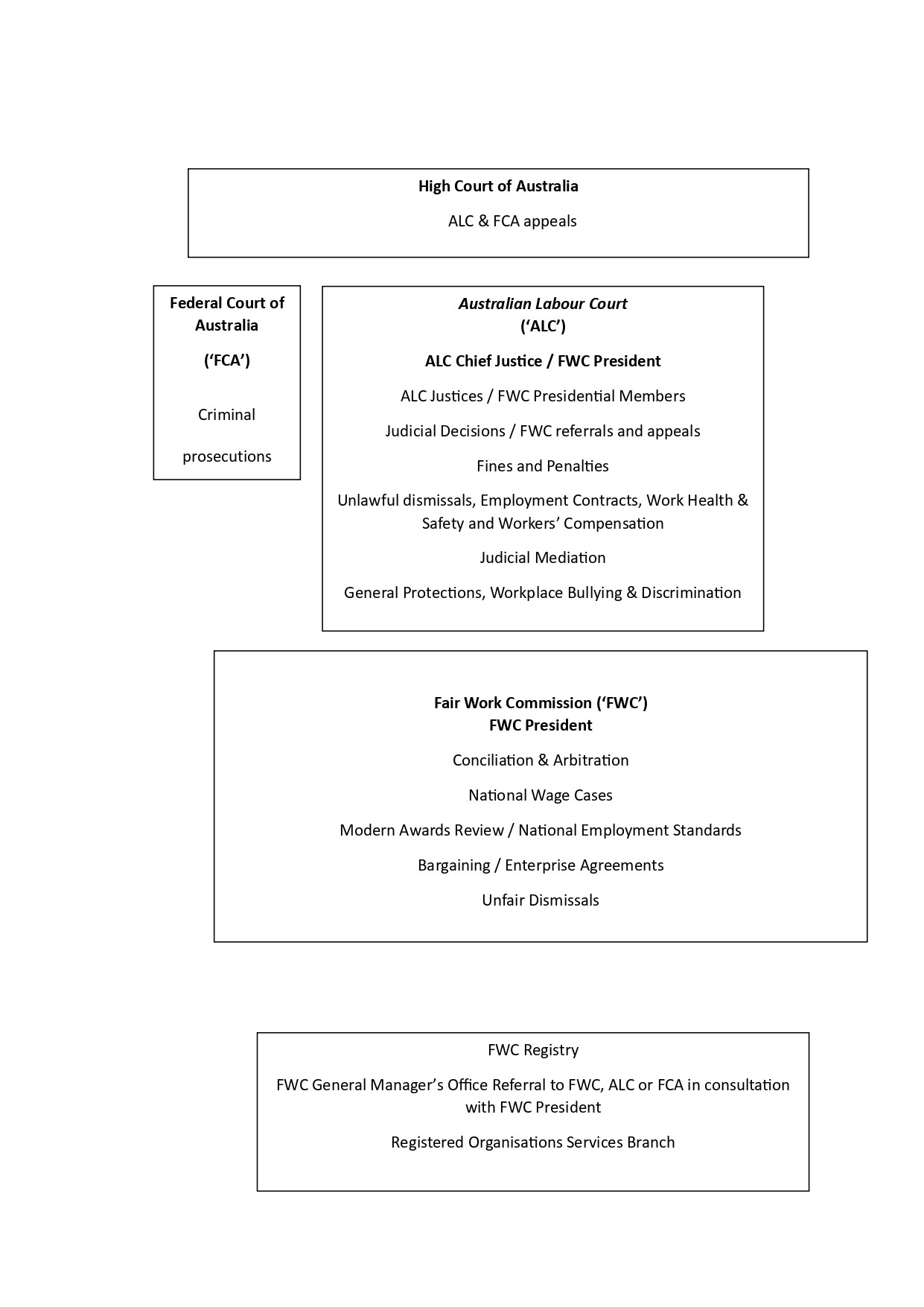
Read a text description of Figure 1
The diagram places the High Court of Australia above the Federal Court of Australia (FCA) and the proposed Australian Labour Court (ALC), with ALC and FCA appeals to the High Court.
- Federal Court of Australia: criminal prosecutions.
- Australian Labour Court: an ALC Chief Justice who is also the Fair Work Commission (FWC) President, and ALC justices who are also FWC Presidential Members. Functions shown are judicial decisions; FWC referrals and appeals; fines and penalties; unlawful dismissals; employment contracts; work health and safety; workers’ compensation; judicial mediation; general protections; workplace bullying and discrimination.
- Fair Work Commission: the FWC President; conciliation and arbitration; national wage cases; modern awards review and National Employment Standards; bargaining and enterprise agreements; unfair dismissals.
- FWC Registry: the General Manager’s Office refers matters to the FWC, ALC or FCA in consultation with the FWC President. The Registered Organisations Services Branch is also shown.
Enabling a One Stop Shop
The proposed labour court needs where possible to be designed, along with the Fair Work Commission, to create a virtual one stop shop for all IR related conciliation, arbitration and separate judicial proceedings. This should also include work health & safety as well as workers compensation. All individual and collective industrial relations and employment law disputes should in the federal system be capable of being settled or determined by the Fair Work Commission and Court.
As previously advised by the late former High Court judge, Mary Gaudron, it is now possible to establish a single unified labour/employment court to deal with all employer-employee matters. 27 This should include individual employees’ right to freedom of association and to be represented by a trade union in collective bargaining as well as the enforcement of rights as an employee. 28 She also claimed it would have jurisdiction over all aspects of workplace discrimination, victimisation and bullying. 29
A new Labour Court could be the linchpin that provides an opportunity for a fresh approach towards enabling a fully integrated unitary IR system. A system that should be simpler and inherently more efficient to access than the current dominant federal jurisdiction and the remaining state-based systems. This could over time create the opportunity for states to either simultaneously or progressively refer IR power to the federal government.
The benefit of a Labour Court should be central to providing judicial authority to a more complete national industrial relations system. However, there are risks of losing the relatively successful operation of the reliable state IR Courts which have otherwise been effective and valuable in each of their respective states. A proposed federal labour court should therefore be required to meet a high threshold of public and stakeholder acceptability if it is proposed to replace state industrial courts. It is the ongoing survival and acceptance of state courts which provides fresh optimism for the future potential of a single Commonwealth court. At a minimum a new Labour or Fair Work Court should enable rather than disable a future unitary IR system.
Declarations: Nil
The full text of John’s Master’s thesis referred to in this article can be found here: University of Melbourne thesis repository
Disclaimer: The views expressed in the Journal of Work and Ideas are those of the authors only. They do not represent the views of the journal, its editors, nor the AIER.
Footnotes
- John Nucifora is a member of the AIER and recently retired as National Compliance and Legal Officer of the Australian Services Union ↩
- ACTU Media Release 23 July 2026 ↩
- David Marin-Guzman, Workplace Correspondent Australian Financial Review 23 July 2026 ↩
- Liberal media release: How will Labor’s Fair Work Court actually work? 23 July 2026 ↩
- Ibid ↩
- Department of Employment and Workplace Relations, Review of the Fair Work Act Small Claims Procedure Report February 2024 25-27 ↩
- R v Joske and Ors; Ex parte Australian Building Construction Employees and Builders Labourers Federation (1973-74) 130 CLR 90 ↩
- Industrial Relations Court of Australia Annual Report 1994-1995 3, (‘IRCA AR 94-95’). ↩
- Industrial Relations Court of Australia Annual Report 1994-1995 19. [3.1], (‘IRCA AR 94-95’).15 [2.6] ↩
- Ibid ↩
- Ibid ↩
- Ibid 4-5 ↩
- Ibid 5 ↩
- Ibid ↩
- Andrew Stewart, ‘Call to empower state IR courts to handle federal cases’, Workplace Express (23 August 2024). ↩
- Farewell to the Hon Justice Murray Wilcox’ (2006) Bar News: Journal of the NSW Bar Association 93 (Web Page) Bar News, Farewell to the Hon Justice Murray Wilcox (2006). ↩
- Fair Work Act 2009 (Cth) s 548 ↩
- ‘Call to empower state IR Courts to handle federal cases’ Workplace Express (23 August 2024) ↩
- Alexander Nucifora, ‘An Australian Labour Court: A critical analysis and proposed reform’ 2026, University of Melbourne thesis repository ↩
- Sarah Murray, ‘Giving Chapter III back its Constitutional Mojo? – Lessons from State Courts and Beyond’, (2014) 40(1) Monash University Law Review 202. ↩
- Grollo v Palmer (1995) 184 CLR 348, 362-5 (Brennan CJ, Deane, Dawson and Toohey JJ). ↩
- Neil Gunningham, Industrial Law and the Constitution, Federation Press, 1988, 8. ↩
- R v Hegartys; Ex parte Salisbury City Corporation (1981) 147 CLR 617. ↩
- Neil Gunningham, Industrial Law and the Constitution, Federation Press, 1988, 9. ↩
- Keith Hancock, ‘Australian Industrial Relations Law and Systems’; (Report of the Committee of Review, April 1985) vol 1-3, vol 1 2 (‘Hancock Report’) ↩
- Federal Court of Australia, Annual Report 2023-2024 pt 2, 14-15. ↩
- ‘Gaudron calls for single labour court’, Workplace Express (26 March 2010). ↩
- Ibid. ↩
- Ibid ↩