
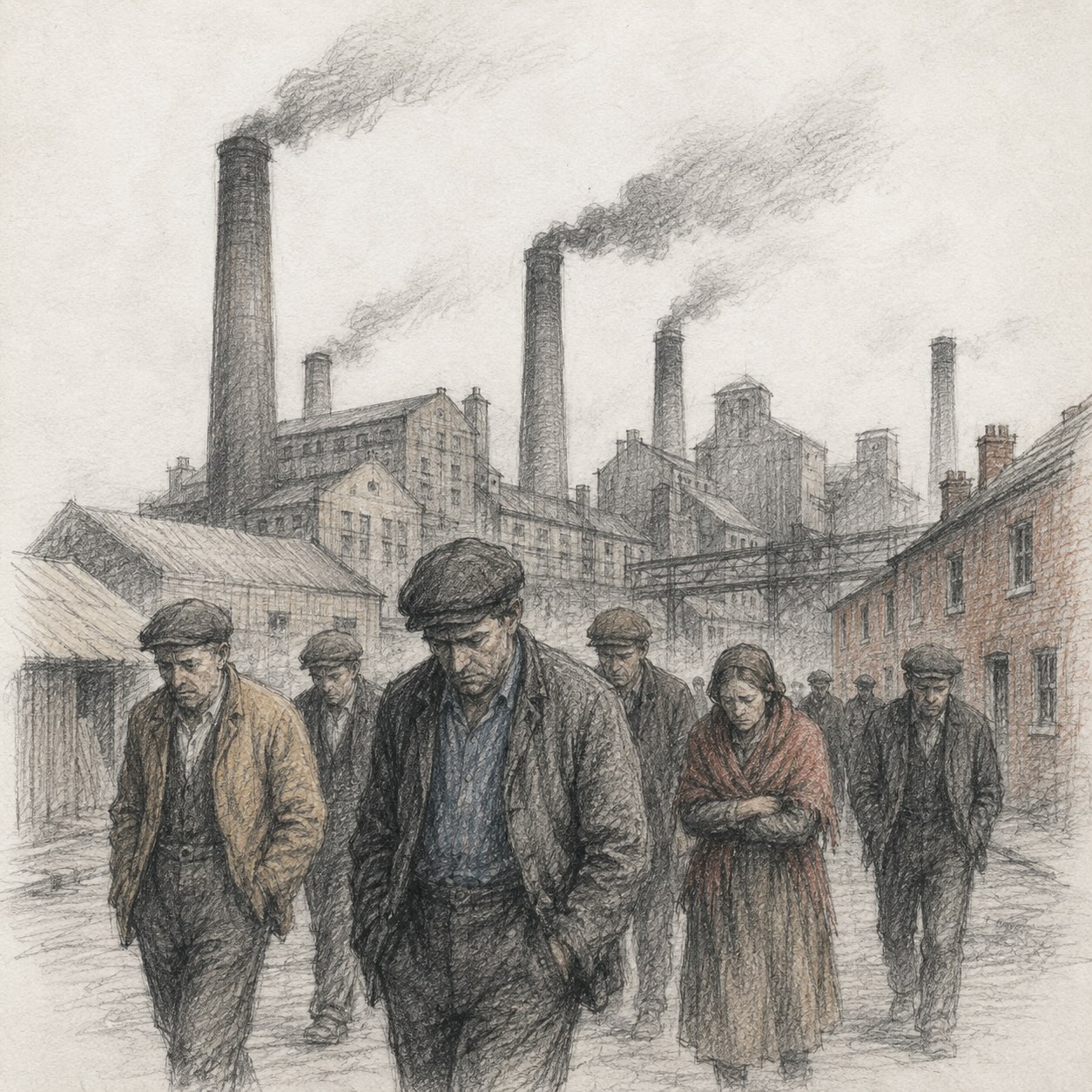
There is a well-recognised sub-genre of literature known as the ‘industrial’ or ‘social conditions’ novel. It is epitomised by novels written in the mid-1800s describing the appalling working and social conditions of the new industrial working classes in post-industrial revolution England.
Examples include Charlotte Bronte’s Shirley, Elizabeth Gaskell’s Mary Barton and North and South, Hard Times by Charles Dickens and Sybil, by Benjamin Disraeli. These novels were written after the Great Reform Bill of 1832 extended the male voting franchise and in the context of the Chartist agitation for greater rights for working people, including the right to form and join trade unions.
Disraeli’s Sybil is interesting for a number of reasons. Firstly, Benjamin Disraeli eventually became a Tory Prime Minister of England but he wrote the novel when he was a leader of the ‘Young England’ movement through which conservative politicians were attempting to broaden their appeal to newly enfranchised voters. Secondly, the novel not only seeks to reveal the lives of the working classes but also to examine the position of Catholics in post-Catholic Emancipation England. The novel’s full title is Sybil, or the two nations, a reference to the great social divide then tearing the country apart.
In Elizabeth Gaskell’s North and South, this divide also has a geographical expression: the difference between the industrialised north of England and the more agricultural south. Bronte’s Shirley is set among the cloth mills of Yorkshire and the recounts the reaction to ‘labour-saving’ machinery and the activities of the Luddites in smashing this new technology. Shirley was published in 1849 but is set in 1811-12 and is based on real historical events. Mary Barton’s fictional father is a trade unionist struggling to do something about this situation. Dickens’s novel Hard Times was published in an accessible serial form and also examined the conditions in the mills and their effects on families. Dickens knew from personal experience the hardships of poverty – he worked in a blacking warehouse while his father was in debtors’ prison.
Other 19th century novels are said to have a social dimension as well but these claims often disappoint. Middlemarch by George Eliot is one such novel. While the main female character says she is interested in forming a ‘colony’, that is, a model industrial community like the real life one run by Robert Owen at New Lanark in Scotland, this theme barely intrudes into the novel’s narrative. The same can be said for Mansfield Park by Jane Austen.
Eliot’s Felix Holt, Radical suggests that is going to be an industrial novel, but the term radical here applies to the political reformers known then as Radicals and the novel deals with a regional election contest rather than industrial work. The political contest is between conservatives and political liberals from the upper classes and does not involve working people.
In France, Emile Zola’s Germinal written in 1884-5 tells a gritty – sometimes melodramatic – story of a coal miners’ strike in the north of the country. There are other, later, examples of literature dealing with working conditions. Robert Tressell’s The Ragged Trousered Philanthropists, was published in 1914 and tells of the work and life experiences of house painters in the south of England. Unlike the earlier novels, it is an avowedly socialist novel, perhaps more in the class of proletarian literature. Thus, it is not just a passive ‘condition of England’ novel which described only ‘what is’ rather it seeks to describe ‘what ought to be’. Dave Harker’s non-fiction book Tressell – the real story of the ragged Trousered Philanthropists – is as, or even more, interesting than the novel itself as it seeks to put the novel’s events and ideas into the actual historical context.
Later again, American John Steinbeck’s novels seek to highlight the struggles of working people in the 1930s USA. In Dubious battle (1936) is set in the midst of a strike by fruit pickers In California and the efforts of union organisers to collectivise them. However, the novel disappoints many readers including this one in that it ends suddenly at a point where it is not clear whether the strikers have won or lost their battle. There is little discussion of the actual conditions of work other than the fact that there was a cut in the pay of the pickers. The novel concentrates on the dynamics of the responses of the striking workers to efforts of two Communist party organisers to guide the strike and the reaction of local authorities. Ultimately, the novel is best seen as a discussion of group psychology than either the conditions of workers or employment justice.
One of Steinbeck’s best-known novels The Grapes of Wrath (1939) depicts the harsh life of mid-West tenant farmers who had migrated west from Oklahoma in the face of drought and the Depression of the 1930s only to meet an almost equally desperate fate on the farms in California. Steinbeck’s novel fits clearly within the ‘social conditions’ genre of literature, describing what is – and what is wrong with that – but does not try to lay out a blueprint for an alternative society.
(Much later, in the 1980s, English novelist David Lodge wrote a clever book Nice Work which extensively references and comments on the ‘industrial’ novels of the previous century. This is worth reading if only because it is a very funny novel in its own right, while paying homage to the earlier social novels.)
An Australian Contribution
Australia has contributed a small number of novels to this genre. William Lane’s The Workingman’s Paradise was published after the 1891 shearer’s strike and before Lane departed Australia to set up a utopian community in Paraguay. It is an urban working-class novel, rather than a ‘bush unionism’ narrative. David Ireland’s Miles Franklin Award-winning novel The Unknown Industrial Prisoner is perhaps the most directly ‘industrial’ Australian novel, as it appears to be set in the oil terminals of Kurnell, south of Sydney. I found its depiction of industrial life simplistic and unrealistic and – deliberately it would seem – absurdist. To my mind, it lacks the power to impress and convince because of its caricatures of both the people and their industrial setting.
There will be other Australian examples of the industrial or social conditions novel of which I am unaware. Frank Hardy’s The Outcasts of Foolgarah might be considered to be one. It is located in the murky world of Sydney suburban council ‘night soil’ workers. But, again, I found it to be too unrealistic to be great or powerful literature. Despite Hardy’s actual experience with a strike by such workers, the characters all appear to be no more than cartoon characters: all one dimensional; either too heroic or completely evil. There is no subtly in this work and no lasting impact.
Utopias – old and new
Many years ago, I read many science fiction ‘classics’. I do not recall any of them dealing specifically with the world of work in the future. However, there are many examples of utopian – and dystopian – novels often written or regarded as sci-fi novels dealing with possible futures of one sort or another.
Some of these attempt to describe future worlds in which issues of work, class and equality have been resolved. These often fail as science fiction and as novels – they are often, to quote one expert ‘boring’ since they are simply descriptions of ideal societies and lack any dramatic element – but nevertheless they have been influential.
One of the most significant of these is Edward Bellamy’s Looking Backward – 2000 to 1887. It is a Rip Van Winkle tale 1 with the main character falling asleep in the Boston of 1887 and waking up in the year 2000. He finds himself in a very different world in which all the issues associated with employment and production have been resolved. Equality and wealth for all – men and women alike – has been realised.
Bellamy’s vision built on the trend in the USA at the time towards the creation of monopolies and his society looks uncannily like a Soviet style planned economy with capitalist monopoly characteristics! The novel, published in 1888, is really an extended essay on the evils of 19th century laissez-faire capitalism as the author observed it at the time. It is quite powerful in its critique of this society which claimed to be Christian but operated on extremely anti-Christian principles in respect to workers generally and women. But like so many utopian novels it lacks a plot or much in the way of dramatic action. It is a long description of a future ideal society, as seen by the author at least.
However, Bellamy’s work was the third most widely read book of its time. Bellamy clubs were set up across America to discuss its ideas and its influence reached Australia. W. G. Spence was said to have read it and William Lane reviewed it in the first issue of The Worker and serialised it over the next nine months.
Apart from some interesting observations on likely technologies in the year 2000, Bellamy’s work is not a good sci-fi read. But the example of Bellamy’s work triggered an increase in the number of utopian novels being written and published. It seems that nearly every author had an attempt at this genre. According to one expert, more than 300 were published in the 19th century – and most of these appeared in the last quarter of the century.
The first ‘modern’ example of the utopian novel was of course that of Thomas More who coined the term itself in the title of his 1516 tract Utopia, the word itself meaning ‘no place’ or ‘nowhere’. The work is, again, essentially descriptive and it is hard to determine now how much of it is seriously meant and how much is simply a critique of Tudor England, of which More was a leading figure until he was beheaded by Henry VIII.
Sixteenth century England was a pre-industrial state but it is worth noting what More said about the organisation of work. In Utopia, work is essentially mandatory but limited to six hours per day. Anticipating a challenge that such limited working hours would not provide society with sufficient output, More notes that six hours would be sufficient since there would be no leisured classes living off the earnings of others, and ‘useless’ and luxury industries and occupations would be eliminated freeing up labour for essential work. There would be no private property (an interesting position for a leading Catholic at the time) but there would be some forced labour to do the worst jobs, provided by those convicted of crimes.
The later utopian novels are too numerous to mention them all, and often are seriously tedious to read. They include Samuel Butler’s 1872 work Erewhon (get it?) – most notable for its three chapters on machines, given that the inhabitants of Erewhon decided to ban all machines made after about 1600 CE as they threatened to enslave humans. It is clear what Butler would have thought about artificial intelligence. Writing 150 years ago he said:
There is no security… against the ultimate development of mechanical consciousness, in the fact of machines possessing little consciousness now. A mollusc has not much consciousness. Reflect on the extraordinary advance which machines have made during the last few hundred years, and note how slowly the animal and vegetable kingdoms are advancing.
The more highly organized machines are creatures not so much of yesterday as of the last 5 minutes, so to speak, in comparison with past time. Assume for the sake of argument that conscious beings have existed for some 20 million years. See what strides machines have made in the last thousand.
William Morris’s News from Nowhere (1890) is another utopian novel where the main character somehow wakes up in the future [this is a common literary device] but in a future in which there has been a reversion to a pre-industrial past. Morris was a wealthy but active 19th century socialist but he rejected modern industrial and city life in favour of rural, handcraft and agricultural life. It has little to offer by way of solutions today, this horse having well and truly bolted.
In many so-called utopian novels, work appears to have been assumed away – somehow food and goods are produced with minimal labour – but it is not usually said how this magical economic system works. But it does raise the question (often not asked and rarely, if at all, answered) as to what the meaning of labour really is. Is it a burden to be avoided or is work an essential part of the human and creative experience?
A major exception to the rule is Emile Zola’s novel Travail [in English, Work] in which the author imagines and creates a model co-operatively based industrial community. Published in 1901, Travail is clearly written to expound the social theories of the French socialist thinker Charles Fourier. Zola’s community is closely based on Fourier’s ideas not only with regard to collectivist and cooperative work organisation but also with regard to the education and raising of children and allowing the freedoms of the human passions.
Fourier imagined that social change could be brought about by the establishment of model communities which would gradually spread as the example of their success became more widely known. Revolution was not needed or helpful. Fourier called these communities ‘phalansteries’ and a number of actual attempts were made to put these ideas into practice. All failed in the short or long term but the idea persists. Zola has a clear vision of what work should be – and what it should not be:
Work, badly remunerated, held in contempt, unjustly apportioned, had become mere torture and shame when it should have been the very nobility, health and happiness of mankind.
In Zola’s ideal community there is also no useless work performed (as in More’s Utopia) and limited to no more than four hours a day and no more than two hours in one occupation or job.
Incidentally, Zola’s novel is farsighted in its enthusiasm for the use of electricity rather than fossil fuels. The steel works is converted to electric power which is also used for lighting. There are electric cars as well, although this idea is not so far-fetched, even for its time. In the early years electricity competed strongly with petrol engines in the vehicle market. But Zola’s most far-reaching idea was to harness solar power and to store it in ‘reservoirs’ for later use. Travail is the ‘utopian’ novel that has most to offer the modern world, in my opinion, at least in its proper conception of the meaning of work and how it should be performed.
Amongst the novels that can be classified as alternative or ‘future histories’ is The Iron Heel by well-known American novelist Jack London. Better known for his novels set in Alaska and the Yukon – Call of the Wild and White Fang – London also tried his hand at a radical novel. It is hard to say whether The Iron Heel – published in 1908 – is utopian or dystopian but it clearly attempts to expound Marxist economic theory including a whole chapter explaining the Marx’s theory of surplus value.
The first part of the novel is Marxist didactics but the remainder tells of a cataclysmic struggle between socialist forces and that of the reaction and response of the ‘Oligarchy’. The struggle results in the defeat of the working-class movements but only, the text suggests, in the short term. It lacks none of the confidence of Marx that the development of contradictions in the capitalist mode of production will eventually and inevitably lead to a successful communist revolution.
In some respects, what the novel does not say is as revealing as what it does depict. For example, while successful socialist uprisings in other countries are mentioned in this alternative future history, Russia is not mentioned in this context. So, as late as nine years before the Bolshevik coup d’etat, a communist revolution in largely agrarian Russia could not be imagined.
A science-fiction approach
In H. G. Well’s science fiction novel The Time Machine [1895] – the first of the time travel novels – the beings of the future have evolved from the past into two distinct races: one living on the earth’s surface and doing little or no work [descendants of the upper classes of 19th century Britain] and another living below ground doing the work [beings who have evolved from the industrial working classes]. The idea of a social divide or the ‘two nations’ could not be starker.
At about the time of the First World War, utopian novels started to give way to depictions of future dystopian societies, in which humans are dominated by work or political forces or both.
One of the most striking examples of this genre – particularly since it appears to have significantly influenced later examples – is We by Russian writer Yevgeny Zamyatin. The author of this dystopian nightmare was a Bolshevik at the time of the Russian revolutions in 1917 – but later fell out with the Bolsheviks and was (luckily) allowed to emigrate. His novel was not allowed to be published in the Soviet Union and first appeared in the West in the 1920s.
We imagines a society governed by the ideas of the American ‘time and motion’ guru F. W. Taylor and the whole society described in We is run on Taylorist principles. People have no names only numbers and work as they are directed by the ultimate ruler. Unfortunately, Zamyatin does not really deal with issues relating to work in such a society – the book is mainly about social control. It foreshadows Orwell’s 1984 in key respects.
Another dystopian future can be found in Huxley’s Brave New World in which – using eugenics – a popular concept on both the right and left of society at the time – workers are bred with particular aptitudes for the most menial or the most intellectual skills and attributes as the economy demands from time to time. Huxley postulates a trade-off between the messiness of freedom and individual choice and the stability of a society which plans everything, including the types of people who will be born.
None of these books really have much to offer to guide us today to a new and more satisfying form of work organisation which might be both more productive, creative and satisfying for workers.
In 1952 sci-fi writer Kurt Vonnegut published his first novel, an alternative history called Player Piano. This novel is set in the USA sometime after World War Three. Nearly all physical work has been automated – machines do all the work managed by a small number of engineers and managers who are the elite of society. All enterprises appear to have been merged into vast conglomerates (a la Bellamy, perhaps).
The mass of workers have been displaced by automation. They are now without meaningful work and must be absorbed into an over-staffed Reconstruction and Reclamation force – known derogatively as the Reeks and Wrecks – or go into the Army. The displaced workers are financially supported through payments that sound a little like a Universal Basic Income, funded by tax on the profits made by the machines. But the work they are doing is not meaningful – and the workers know it.
A rebellion against this system and the machines occurs, led by a small number of renegade engineers, but it fails. In the initial stages of the revolt the displaced workers smash the machines. Ultimately, however, the workers start rebuilding the machines. Like 1984 perhaps, the workers begin to love not Big Brother but the machines. At this point, the leaders of the uprising surrender to the authorities.
Vonnegut’s novel is dystopian in its conclusion but powerfully makes the point that humans need meaningful work that provides both income and an opportunity to create a better future.
A number of other more recent science fiction/utopian novels have attempted to deal with work issues. These include, of course, the modern classic The Dispossessed by Ursula Le Guin. In this novel, on one planet, where economic resources are scarce, work is necessary and socially directed using moral suasion. Private capital accumulation is not allowed.
A present-day author who has sought to deal with some of these issues is Kim Stanley Robinson, author of the Red Mars series but also of the novel 2312 in which a series of worlds which operate on the principles of the [real life] Mondragon Cooperative community in the Basque region of Spain are described. But even these novels emphasise the scientific means of adapting to life on other planets and moons in the Solar System and much less on how this cooperative work and economic model might work in principle.
Marge Piercy’s Woman on the Edge of Time is a feminist novel imaging a very different world in the future. But again, the economics of work and production are not clear. Most industrial work is automated (as in Player Piano) but people work hard in food production and other activities, including cultural ones. As in More’s Utopia, unnecessary work is not done, for example “the jobs telling people what to do, counting money and moving it about…” thus freeing up for work feeding the population in an agrarian economy similar to Morris’s ideal (but with smart watches). But how the economics of all this works is not clear in this otherwise very imaginative – and very readable – alternative world [noting that it suggests strongly that this is only one possible future and others, much less attractive, are possible].
Piercy’s work was pre-dated by Charlotte Perkins Gillman’s utopian novel Herland (1915) – a society composed only of females who have managed to work out how reproduction of the species can take place without the need for males. Herland has a system of work that has echoes of More’s society but can be taken more seriously since the novel was clearly designed to give life to the ideas Gillman expressed in her 1898 non-fiction book: Women and Economics: A Study of the Economic Relation Between Men and Women as a Factor in Social Evolution in which she criticises the economic dependency of women on men.
There are a number of key themes running through these various novels. Initially, writers sought to describe the social and industrial conditions under which most workers laboured. While pointing to the injustice and unfairness inherent in a capitalist economy, no specific solutions were offered. Other authors offered descriptions of model or utopian societies, often ones in which work was largely eliminated and replaced with leisure or cultural activities.
Later, writers were concerned about either the disappearance of real work and the displacement of workers (Vonnegut) or the domination of human beings by new methods of industrial and social control over work systems (Zamyatin). Most utopian/dystopian novels seek to grapple with the question as to whether a highly advanced society can remain genuinely human and satisfying, without reverting to pre-industrial modes of industry and employment. The challenges of Artificial Intelligence which seeks to now automate thinking work the way earlier industrial revolutions automated physical work makes this challenge even more pressing and ominous (Vonnegut was aware of this possibility in 1952).
It seems clear from these novels that human beings do not need just consumption and leisure activities to fill their days but need to be engaged in meaningful and creative work useful to themselves and humanity, carried out under conditions of dignity, autonomy, fellowship and respect.
The novel which best imagines a world in which realistic economic output can be achieved in conditions in which humans can thrive personally and socially is, perhaps, yet to be written. Problems of economics and work cannot be assumed away, but these novels do all, in one way or another raise questions about the purpose of work and how it can be best structured so that human beings get a life and work experience that is deserving of their humanity.
My vote goes for the novels of Kim Stanley Robinson (in the modern era) but also for Emile Zola’s vision of a cooperative work community being neither dystopian or outrageously and unrealistically utopian.
You can read an interview with Kim Stanley Robinson conducted by the author here.
Declaration of interests
Nil.
© Keith Harvey 2026